lauantai 1. kesäkuuta 2019

C for Chaos Witch

Chaos/Chaotic - A type of magick utilizing new, non-traditional, and unorthodox methods. It is a new and highly individualistic practice, while still drawing from other common forms of magick.

My research for Chaos majick or Chaos witches has took me to longest this far. Didn´t know much about it, everywhere I looked, there was a totally different approach of it. So just imagine, I was super confused. What the hell is this thing? Can´t they explain it the way I would understand it? Then I decided to watch few videos about it from Youtube (witchcraft in Youtube is strong!). After the videos I actually interviewed few Chaos witches and all became finally clear. Actually the practice is really simple. There is few things that I realize it has and yet again, like every Chaos witch, I say, this is just my point of view. 


2010-2013


-First of all what became clear to me, is the dogmatism, it´s really strong with the idea of "viewpoint or system of ideas based on insufficiently examined premises." Basically, nothing may be true, you need to find more resources to back the "facts" or opinions and learn learn learn. This is the reason why every Chaos witch say the different thing, we all have different approaches and ideas and because you can do your stuff and do your magick the way you want... This may be confusing to some (like to me in the beginning). 

-Nothing is written on the stone, you can pick what ever floats your boat and make your magick, the outcome work. Many Chaos witch may use book of shadows or journals to write the whole process down or even revolve with different starting points and add them to their studies. What premises help you to achieve your goal the best?

-You can change your mind at any point.

2014-2016


-Chaos witches are very good at their technical experiences. Because all the learning and analyzing about everything, they became very (with no other words in my mind) officiant the things they do. So actually, chaos magick isn´t chaotic at all, it is very straight and in place at all time. Only thing that may seem chaotic, is the process to getting there for seen, nothing is certain.

-Deconditioning. Totally new word to me, but it means (very psychologically) that our ego and everything that includes us to think who we are, need to be kind of re-programmed. You don´t need to think you are everything that has happened to you, that those things are the only thing you are. You can wide your self-image; who you are is up to you. How much do you want to enjoy life and be the better you.

 "Our ego is a fiction of stable self-hood which maintains itself by perpetuating the distinctions of ‘what I am/what I am not, what I like/what I don’t like’, beliefs about ones politics, religion, gender preference, degree of free will, race, subculture etc all help maintain a stable sense of self, whilst the little ways in which we pull against this very stability allows us to feel as though we are unique individuals. Using deconditioning exercises, we can start to widen the cracks in our consensual reality which hopefully, enables us to become less attached to our beliefs and egofictions, and thus able to discard or modify them when appropriate."


-Gnosis. Ability to enter altered states of consciousness. 

"We tend to draw a distinct line between ‘ordinary consciousness’ and ‘altered states’, where in fact we move between different states of consciousness - such as daydreams, ‘autopilot’ (where we carry out actions without cognition) and varying degrees of attention, all the time. However, as far as magick is concerned, the willed entry into intense altered states can be divided into two poles of ‘Physiological Gnosis’ - Inhibitory states, and Excitatory states. The former includes physically ‘passive’ techniques such as meditation, yoga, scrying, contemplation and sensory deprivation while the latter includes chanting, drumming, dance, emotional and sexual arousal."

So, conclusion.

"Rather than trying to recover and maintain a tradition that links back to the past (and former glories), Chaos magic is an approach that enables the individual to use anything that s/he thinks is suitable as a temporary belief or symbol system. What matters is the results you get, not the ‘authenticity’ of the system used. So Chaos magic then, is not a system - it utilises systems and encourages adherents to devise their own, giving magic a truly Postmodernist flavour."

"Chaos magic has a reputation being sinister or some type bad. Maybe because the name is what it is or,  "its “pick’n’mix/D.I.Y” approach to magic was frowned upon by the ‘traditionalist’ schools, secondly that many people associated chaos with ‘anarchy’ and other negative associations, and thirdly that some Chaos magic publications were hyped as being ‘blasphemous, sinister, and dangerous’ in a way that they were not, which proved all the same to be an attractive glamour for those who required such a boost to the ego." "


Tips for making sigils

-Use positive affirmations. Take the “not” out of your sigil. Sigils use your subconscious to manifest, and in much the same way that your first response when someone tells you “don’t look over there,” is to ignore them and look where they just told you not to, your subconscious will skip right over the “not” and fuck with your results. For example, “I am strong,” versus “I am not weak,” where “I am strong” carries the positive affirmations and “I am not weak” carries negative affirmations. Your subconscious takes “I am not weak” and crosses out the “not” and sees it instead as “I am weak,” and therefore your sigil may manifest the complete opposite of what you had intended.


-Use present tense as opposed to future tense. I’ve learned from experience to not leave room for loopholes, and using “I will” instead of “I am” leaves some room for loopholes. The phrase “I will be strong” leaves an open loophole where your sigil could start working right away as you intended it, or, in the case that the universe decides to be a little fucker as it so often does, a year from now. “I am strong” denotes that this is a thing that is happening now, so it’ll manifest now as opposed to later when it might not even matter anymore. If you have to use the word “will,” then the phrase “it is my will” may work for you. 

However, if your sigil is something that you planned on manifesting sometime in the future, (“i will meet my soulmate”) then go ahead and use “I will” in your phrasing. 

-Your sigil has to be charged AND activated. Not one or the other. Both. There are a number of methods and combination of methods to achieve this, but it’s important that you do both or your desire will not manifest.

Read a book/ All quotes:
http://www.philhine.org.uk/writings/pdfs/orchaos.pdf


Nothing is true. Everything is permitted.

Blessed be!

maanantai 27. toukokuuta 2019

C for Ceremonial Witch

Ceremonial Witch: Witches who combines both the practices of witchcraft and ceremonial magic, though they are more spiritually centered than most ceremonial magicians. Ceremonial witches are very exacting in the performance of ritual and their rituals are usually followed by the book, to the letter and with much ceremony. They may use a combination of various mystical disciplines drawn from the Old Ways, but will often incorporate scientific approaches such as sacred mathematics and quantum mysticism as well.  They will call upon a eclectic band of spiritual entities, leaning towards archetypal figures representative of the energies they wish to manifest.

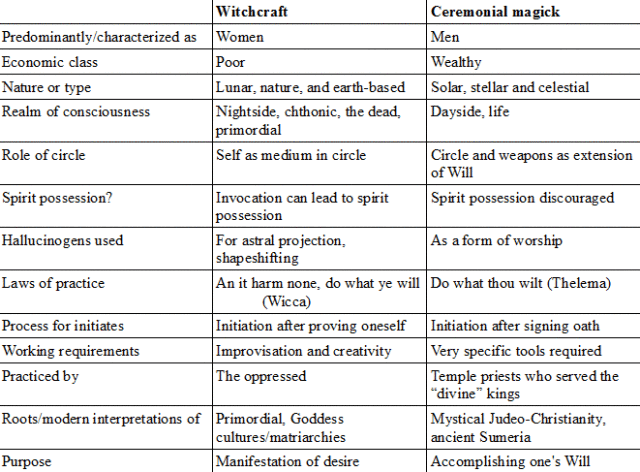
Specific tools, high magick, wealthy people with clear will in mind, lots and lots of mystical and very old occult symbols trough time. Those who got the chance to practice ceremonial magick, signed an oath and studied hard. With this post I wanted to share mostly how ceremonial magick works, finding the ways how to combine both witchcraft and ceremonial magick was really hard. I have been doing research the whole day and I think I have only touch the surface. This seem highly interesting way to study and use magic. I am not that ceremonial myself, I do my ritual when ever I feel like and this probably wouldn´t be my thing. Study thing interests me a lot though, maybe I buy more books and do my own type of thing reading and doing my notes. Maybe even doing more magic/paranormal/occult related posts in my blog.

“…the Magi were  holy men, who, setting themselves apart from everything else on this earth, contemplated the divine virtues and understood the divine nature of the gods and spirits, the more clearly; and so, initiated others into the same mysteries, which consist in one holding an uninterrupted intercourse with these invisible beings during life.”
— H.P. Blavatsky, Isis Unveiled

How witchcraft and ceremonial magick are different:


Definition
Ceremonial magick is also known as high magick or learned magick.  It is a system using long, formal rituals and using multiple ritual tools.  Ceremonial witchcraft is often influenced by Hermetic, Thelma, and Western Esoteric practices.  Often times a practitioner of ceremonial magick may refer to themselves as a magickian.  Although ceremonial practitioners perform a variety of rituals, there seems to be a special connection between ceremonial magick and the spirit world.


Historic Context
The earliest discussion of the term ‘ceremonial magic(k)’ can be found in the 16th century to describe medieval grimoires and techniques.  Heinrich Cornelius  Agrippa, a German occult writer, understood there to be a division between natural magick (astrology, alchemy, and modern natural sciences)  and ceremonial magick (communing with spirits, necromancy, formal ritual).  He approved of the natural techniques but found ceremonial magick to be sinful.  The most recent revival of ceremonial magick was partly caused by the writings of Aleister Crowley.

Modern Context
There are many practitioners who work solely with ceremonial magick and/or who identify as ceremonial magickians/witches/practitioners.  Others, simply use ceremonial magick as inspiration either for their practice as a whole or individual spells and rituals. Such witches might identify as eclectic.

Try it
Take some time to write your own spell or ritual with ceremonial elements including a plan, collected supplies, and formal verbal ques.


CEREMONIAL magic is the ancient art of invoking and controlling spirits by a scientific application of certain formulæ. A magician, enveloped in sanctified vestments and carrying a wand inscribed with hieroglyphic figures, could by the power vested in certain words and symbols control the invisible inhabitants of the elements and of the astral world.

While the elaborate ceremonial magic of antiquity was not necessarily evil, there arose from its perversion several false schools of sorcery, or black magic.

Egypt, a great center of learning and the birthplace of many arts and sciences, furnished an ideal environment for transcendental experimentation. Here the black magicians of Atlantis continued to exercise their superhuman powers until they had completely undermined and corrupted the morals of the primitive Mysteries. By establishing a sacerdotal caste they usurped the position formerly occupied by the initiates, and seized the reins of spiritual government. Thus black magic dictated the state religion and paralyzed the intellectual and spiritual activities of the individual by demanding his complete and unhesitating acquiescence in the dogma formulated by the priestcraft. The Pharaoh became a puppet in the hands of the Scarlet Council–a committee of arch-sorcerers elevated to power by the priesthood.

These sorcerers then began the systematic destruction of all keys to the ancient wisdom, so that none might have access to the knowledge necessary to reach adeptship without first becoming one of their order. They mutilated the rituals of the Mysteries while professing to preserve them, so that even though the neophyte passed through the degrees he could not secure the knowledge to which he was entitled. Idolatry was introduced by encouraging the worship of the images which in the beginning the wise had erected solely as symbols for study and meditation. False interpretations were given to the emblems and figures of the Mysteries, and elaborate theologies were created to confuse the minds of their devotees. The masses, deprived of their birthright of understanding and groveling in ignorance, eventually became the abject slaves of the spiritual impostors. Superstition universally prevailed and the black magicians completely dominated national affairs, with the result that humanity still suffers from the sophistries of the priestcrafts of Atlantis and Egypt.

Fully convinced that their Scriptures sanctioned it, numerous mediæval Qabbalists devoted their lives to the practice of ceremonial magic. The transcendentalism of the Qabbalists is founded upon the ancient and magical formula of King Solomon, who has long been considered by the Jews as the prince of ceremonial magicians.


Among the Qabbalists of the Middle Ages were a great number of black magicians who strayed from the noble concepts of the Sepher Yetzirah and became enmeshed in demonism and witchcraft. They sought to substitute magic mirrors, consecrated daggers, and circles spread around posts of coffin nails, for the living of that virtuous life which, without the assistance of complicated rituals or submundane creatures, unfailingly brings man to the state of true individual completion.

Those who sought to control elemental spirits through ceremonial magic did so largely with the hope of securing from the invisible worlds either rare knowledge or supernatural power. The little red demon of Napoleon Bonaparte and the infamous oracular heads of de Medici are examples of the disastrous results of permitting elemental beings to dictate the course of human procedure. While the learned and godlike dæmon of Socrates seems to have been an exception, this really proves that the intellectual and moral status of the magician has much to do with the type of elemental he is capable of invoking. But even the dæmon of Socrates deserted the philosopher when the sentence of death was passed.

Transcendentalism and all forms of phenomenalistic magic are but blind alleys–outgrowths of Atlantean sorcery; and those who forsake the straight path of philosophy to wander therein almost invariably fall victims to their imprudence. Man, incapable of controlling his own appetites, is not equal to the task of governing the fiery and tempestuous elemental spirits.


Many a magician has lost his life as the result of opening a way whereby submundane creatures could become active participants in his affairs.

When Eliphas Levi invoked the spirit of Apollonius of Tyana, what did he hope to accomplish? Is the gratification of curiosity a motive sufficient to warrant the devotion of an entire lifetime to a dangerous and unprofitable pursuit? If the living Apollonius refused to divulge his secrets to the profane, is there any probability that after death he would disclose them to the curious-minded? Levi himself did not dare to assert that the specter which appeared to him was actually the great philosopher, for Levi realized only too well the proclivity of elementals to impersonate those who have passed on.

The majority of modern mediumistic apparitions are but elemental creatures masquerading through bodies composed of thought substance supplied by the very persons desiring to behold these wraiths of decarnate beings.

Source: Secret Teachings of All Ages


Blessed be!

torstai 23. toukokuuta 2019

C for Celtic witch


May the rains sweep gentle across your fields.
May the sun warm the land.
May every good seed you have planted bear fruit.
And late summer find you standing in fields of plenty.
—  Irish blessing

  • Celtic - Magickal practice that is based from the Celtic culture, including its’ mythology, deities, old ways, and (occasionally) language / symbols. May also describe those who only worship Celtic gods.

Horned God and Mother Goddess, Triple Goddess, loving the earth, elements, fairies.. I love all of it, it is so basic me. Even when I was very little I was so intrigued by everything Celtic, the history, the magic, the people. How I use Celtic witchcraft in my own craft? Well, I meditate while listening Celtic music, I watch movies based on it, every Sabbath I remember Celtic Gods and Goddesses and many deities. I also wear jewellery, I often go to the woods and just be there in silence or just go for a walk. I have been obsessed in all Celtic stuff past year because I just didn´t know how I want to present this post and this has been taking way too long now.


Few of my favorite Goddesses:

Badb (Irish) - A shape-shifting, warrior goddess who symbolises life and death, wisdom and inspiration. She is an aspect of Morrigan.
Branwen (Welsh) – The Welsh goddess of love. Her name means “blessed raven.” Bronwyn is a modern day version of this name.
Brigid (Irish) – This fire goddess’s name means “bright arrow.” Her myths spread into England and Scotland where she is known as Brigantia and Bride respectively. The modern name Bridget derives from this popular triple goddess.

Brigid In the Kitchen - Traditional Prayer

Brigid, bless the things I create
And the things I did not create:
Honey from the hive,
Milk from the cow,
Salt from the sea.

Cerridwen  (Irish) – Keeper of the cauldron, goddess of the moon, magic, agriculture, poetry, music, art and science. Her name means “chiding love.” Other common spellings of her name include Cerridwen, Caridwen and Keridwen.
Maeve (Irish) – A warrior queen.
Morrigan  (Ireland) - A terrifying crow goddess associated with war and death. She is queen of phantoms, demons, shape-shifters and witches
Rhiannon, who was chased by mortals who could never catch her because her horse moved magically fast. And then one of them begged her to stop and she did, saying it would have been much better for his horse if he had asked before. Rhiannon loves music, and she has birds flying around her head whose song can lure dead people back to life.

Devotional acts for The Morrigan

-Listen to a song that reminds you of her
-Paint your nails black or red while thinking of her
-Dedicate your cigarette smoke to her while you’re smoking
-Light some incense for her (for example, dragonblood incense)
-Share the meal you’re eating
-Pour some red wine for her
-Look up some fun facts about crows
-Change your phone background in an image of her
-Draw or paint her
-Do some scrying
-Watch a documentary about the Celts
-Meditate while focusing on her energy
-Cleanse her altar (if you have one for her)
-Write down a prayer
-Light a black candle
-Make a jar for her
-Write something about her in your book of shadows/grimoire
-Do a tarot reading to understand her better
-Go into the woods and when you’re alone scream at the top of your lungs
-Just scream
-Keep screaming

King Arthur: The Legend of the Sword


Celtic witchcraft has as its basis a strong sense of spirituality and a love of the earth. Central to this love are the Goddesses and Gods, who play a strong role in Celtic worship. The Celtic religion recognises two main deities; the Earth Mother Goddess and the Horned God. But Celtic Wiccans also worship many other minor deities who each represent specific qualities important to Celtic individuals. Celtic worshippers celebrate the same Sabbaths, perform rituals and magic, and have a strong faith in their spirituality, just like any member of the Craft. The main differences between Celtic witchcraft and other forms of the Craft is that with Celts, magic is everywhere. Magic is woven into their jewellery, their tattoos and all their artwork and everyday items such as clothing and cutlery. 
  
  The Druids are the religious leaders of the Celtic people,the wise and magical priests and priestesses whose special blend of wisdom and magic provided a powerful role model for all the Celtic people. The Druidic priesthood was originally all-female, which male initiates only becoming accepted after many years. 
  
  According to Laurie Cabot, Druidesses were divided into three levels, or classes: the highest class were celibate and lived in convents, and were eventually assimilated into Christianity as nuns. The other two levels could be married and lived either with their husbands, or in the temples. With the onset of Christianity these wise women were called witches. 
  
  Spirituality is of primary import to Celts, and their devotion to the earth, their goddesses and gods and the effort which they put into their worship is proof of their highly spiritual nature. Although the names of the deities worshipped and the titles of the Sabbats may be different to other Pagan practices, despite the regional dialects which occur in the Celtic rituals, there are strong similarities between Celtic witchcraft and Wicca practiced elsewhere on the globe.
 In Celtic witchcraft, rituals honor the essential elements of earth, air, fire and water, and the deities that personify them. Rituals are held in honor of the seasons, the Sabbats and to celebrate auspicious moments in pagan history. Numbers are extremely important to the Celts, with three, five, seven, nine and thirteen holding special significance. Therefore it is auspicious to repeat rituals or affirmations a specific number of times. 


Mists of Avalon

Ritual is vital for Celtic magic. The wearing of ceremonial robes, the burning of incense and candles, and the tools on the ceremonial altar - all play an important role in setting the scene for magic. Magic is an often overused term, but those in the Craft know that it works. With spellcraft one can practice and see the results of magic, constantly gaining strength with each day that passes. 
  
  Candle magic was greatly favored by the Celts, although they preferred tallow lamps and bonfires using specific woods to modern candles we use today. Candle rituals are specific to the individual, but there are a few simple rules to follow unless the ritual specifies otherwise. To perform a spell to increase or obtain, burn during a waxing moon (the period leading up to the full moon). To decrease or remove, burn during a waning moon (the period after the full moon). 
  
  Use candles of a specific color relevant to your spell. Anoint the candle with incense or oil, working from bottom to top for a spell to increase or from top to bottom for a spell to remove. You may also wish to each words, such as your desires or the name of the deity to whom you are appealing, along the side of the candle to strengthen the purpose of the spell. When performing a ritual with a candle, unless otherwise stipulated, allow the candle to burn out to the end. 


Next time: Ceremonial Witch